Launch offer — valid today only

📄 Digital book in PDF · read it on your phone or print it

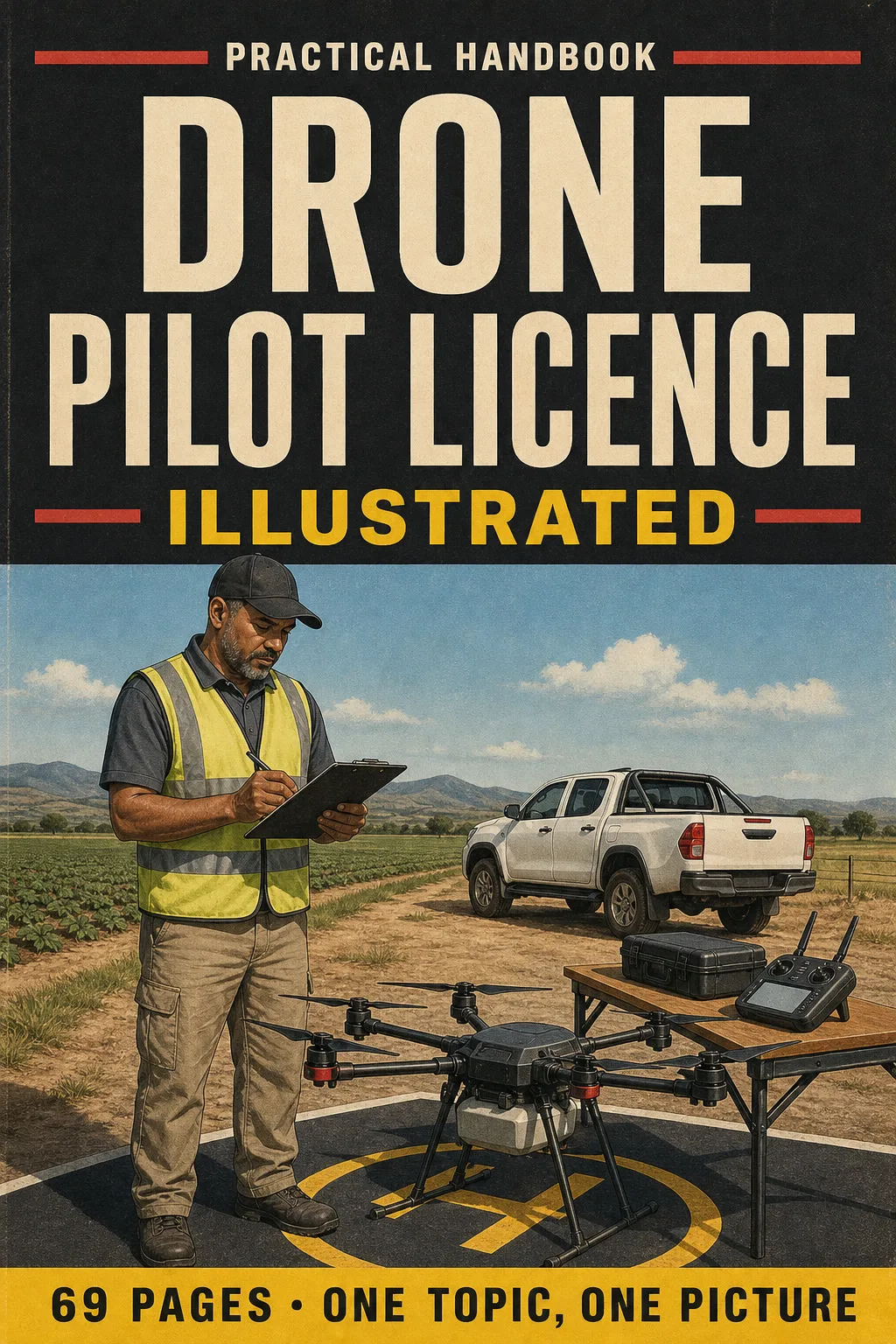
Drone Pilot Licence Illustrated: RPL Theory in Drawings, So You Know Where You Can Fly One Topic on Every Page

Written for the South African Remote Pilot Licence: air law under Part 101, airspace and charts, wind in km/h and knots, METAR and TAF, LiPo batteries, radio calls, the pre-flight check and emergencies. Every topic has its own page: the drawing first, then what you need to remember. 69 illustrated pages.

START STUDYING THIS WAY

🔒 Secure checkout · PDF by email · 30-day guarantee

Every topic, its own pageEvery rule and procedure drawn, with the explanation alongside
69 illustrated pages69 illustrated pages in 8 parts, from what the licence lets you do to the final checklist
Up-to-date sourcesChecked against the Civil Aviation Regulations Part 101, its Technical Standards and the Part 172 airspace rules
PDF by emailFormat

Look Inside the Book

Every page has one big drawing and a box with the numbers, rules and steps you need to know:

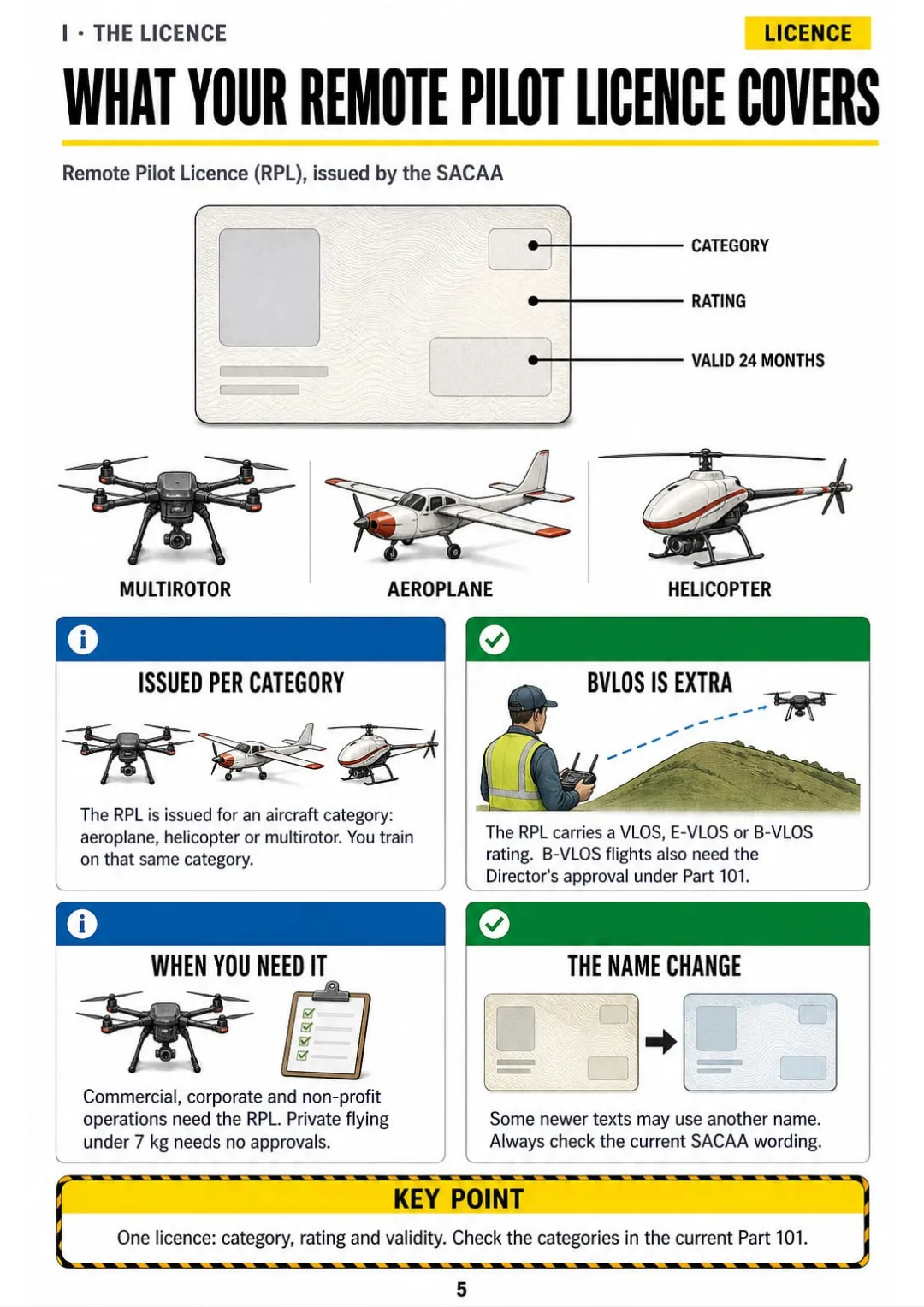
RPC (still called RPL): issued per category, aeroplane, helicopter or multirotor; BVLOS needs its own rating
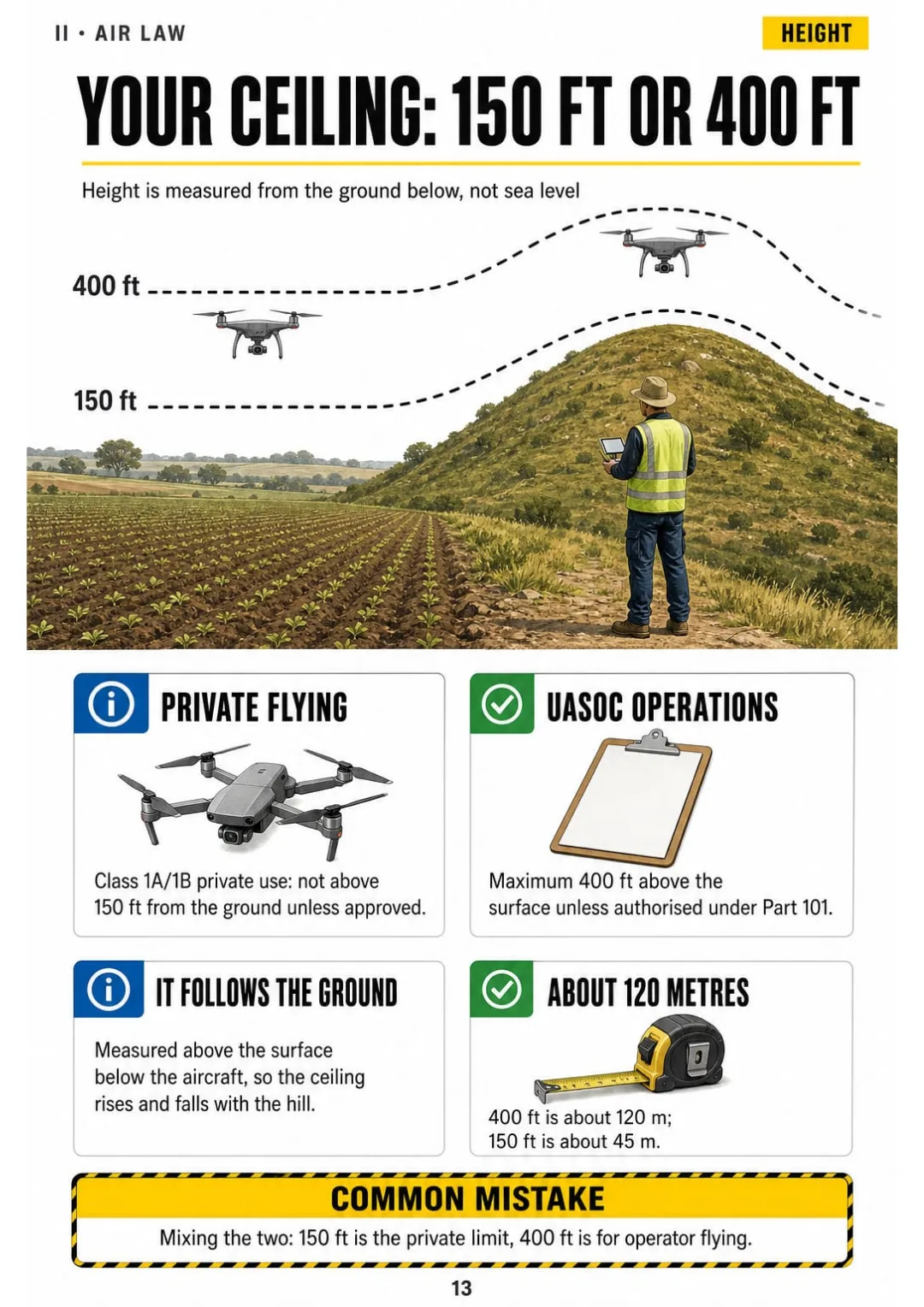
150 ft for private flying, 400 ft AGL for UASOC operations, both measured from the ground
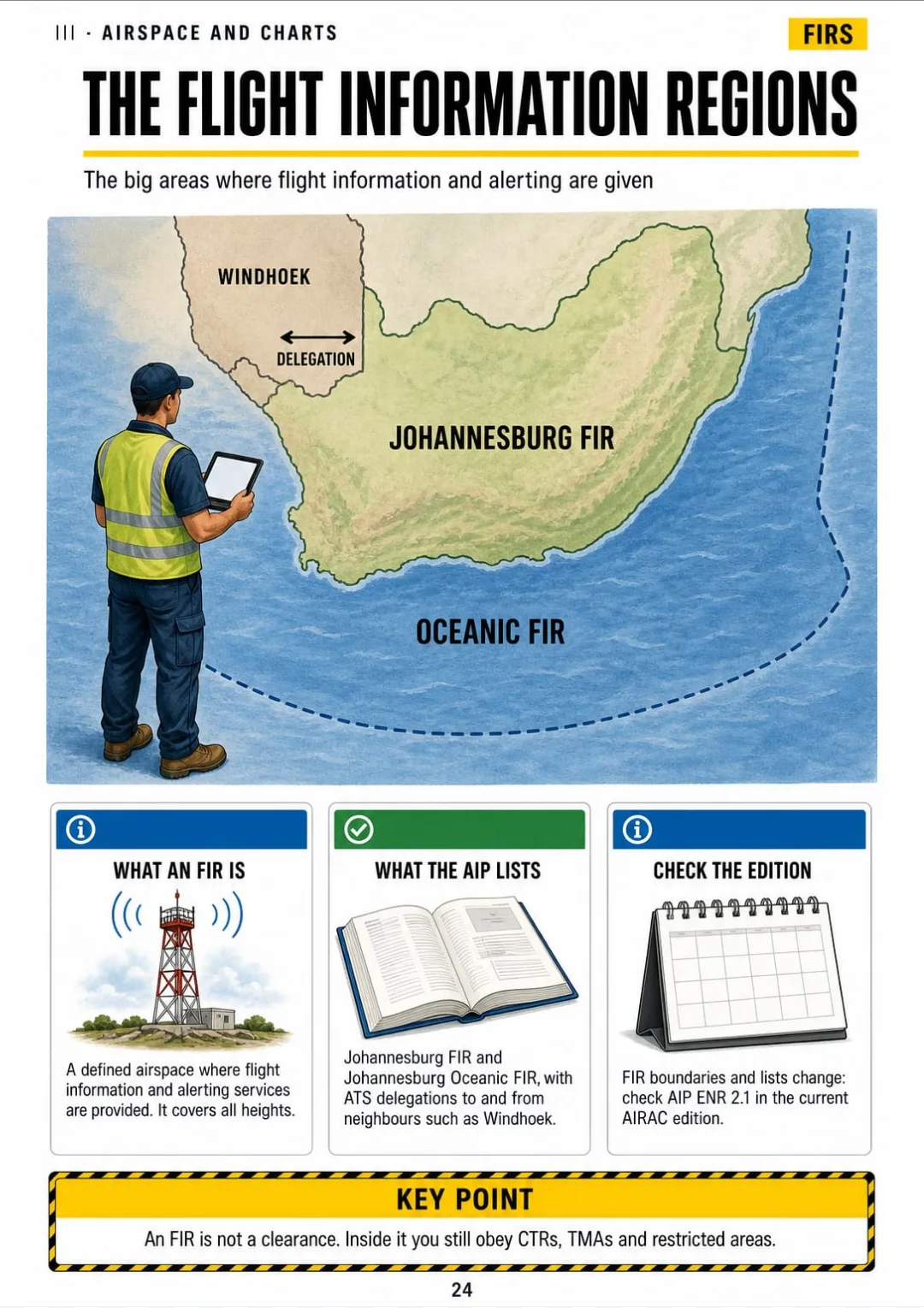
The SA AIP lists the Johannesburg FIR and the Johannesburg Oceanic FIR.
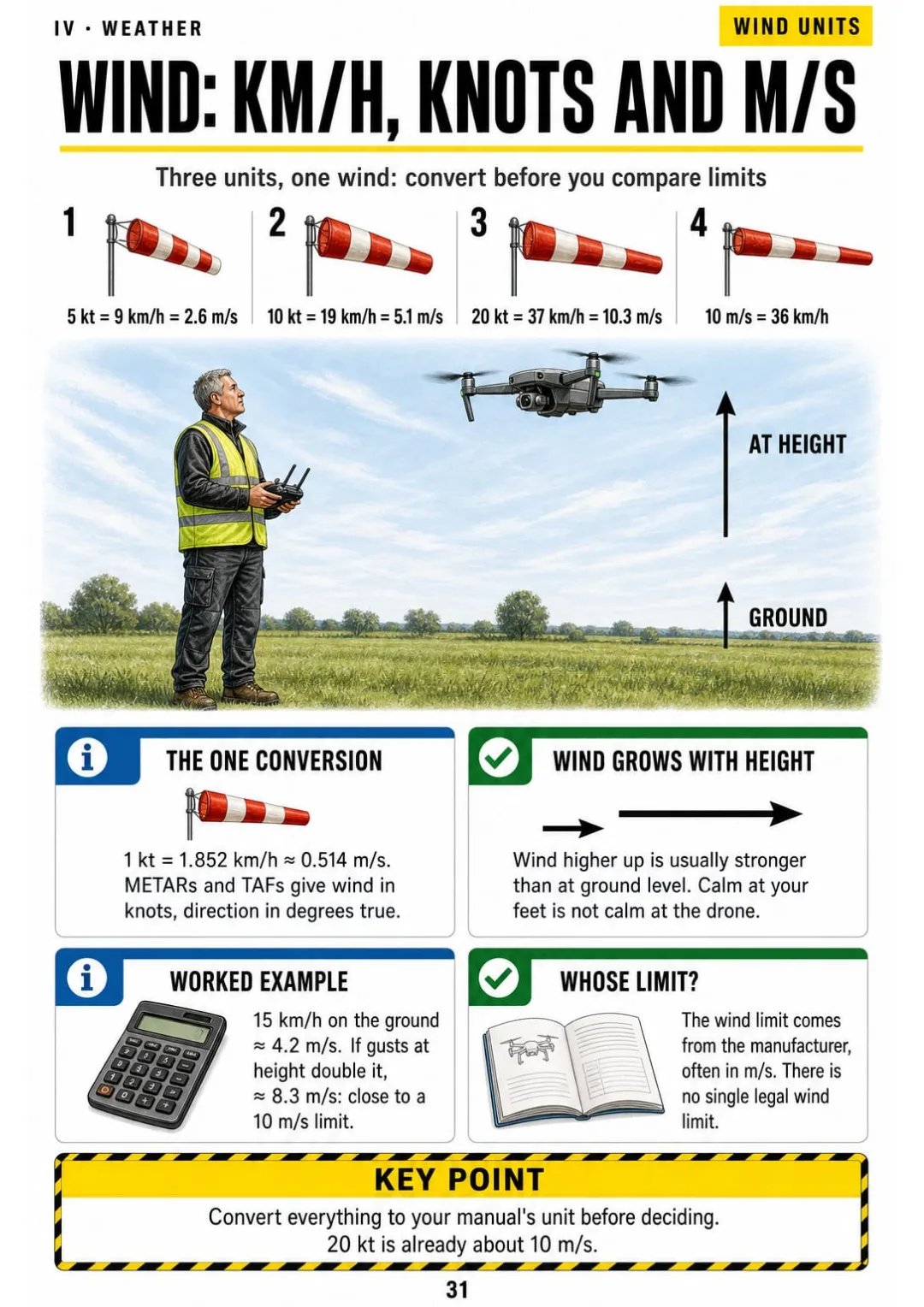
1 kt = 1.852 km/h ≈ 0.514 m/s · 20 kt ≈ 37 km/h ≈ 10.3 m/s
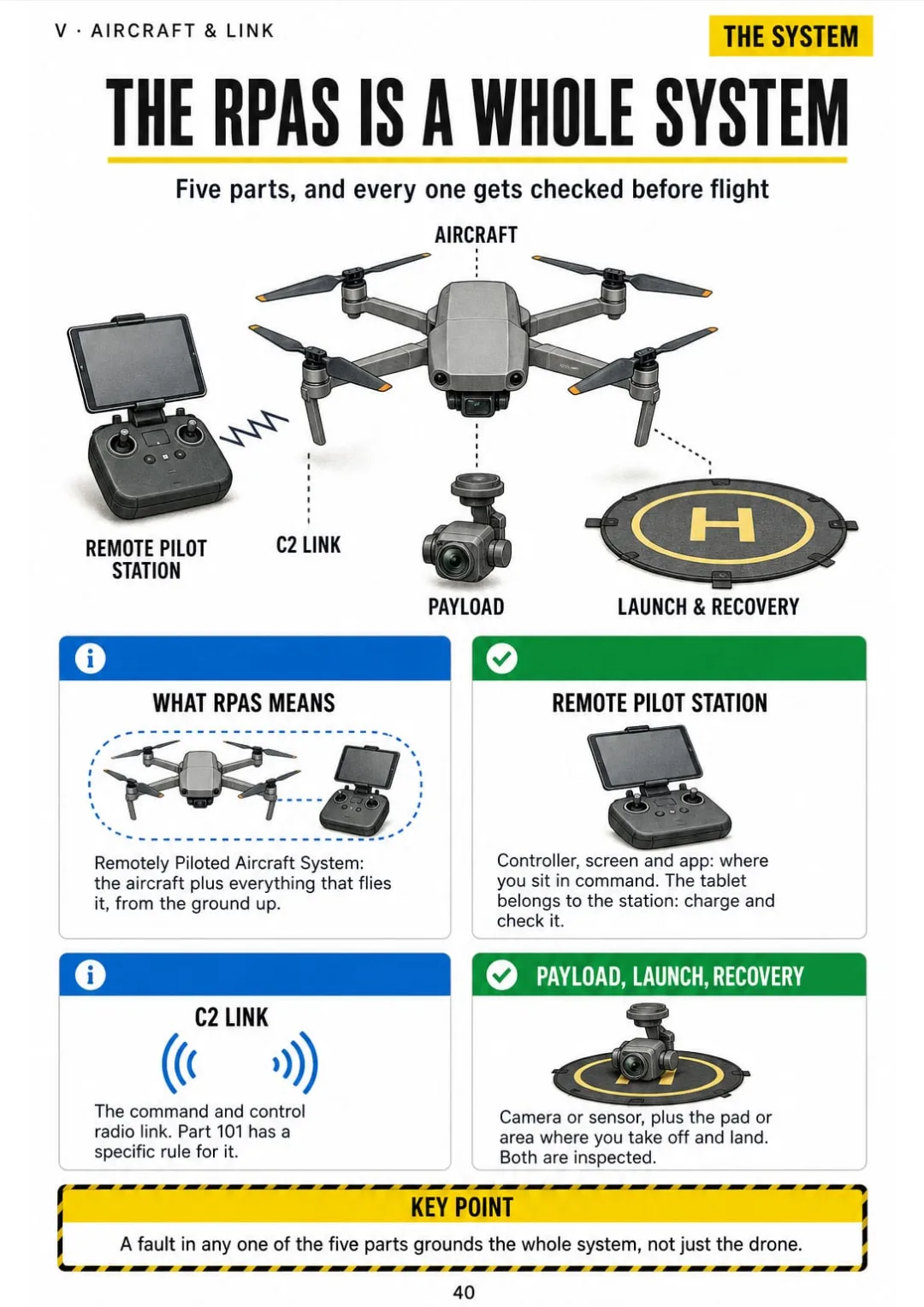
Aircraft, pilot station, C2 link, payload, launch and recovery: one system
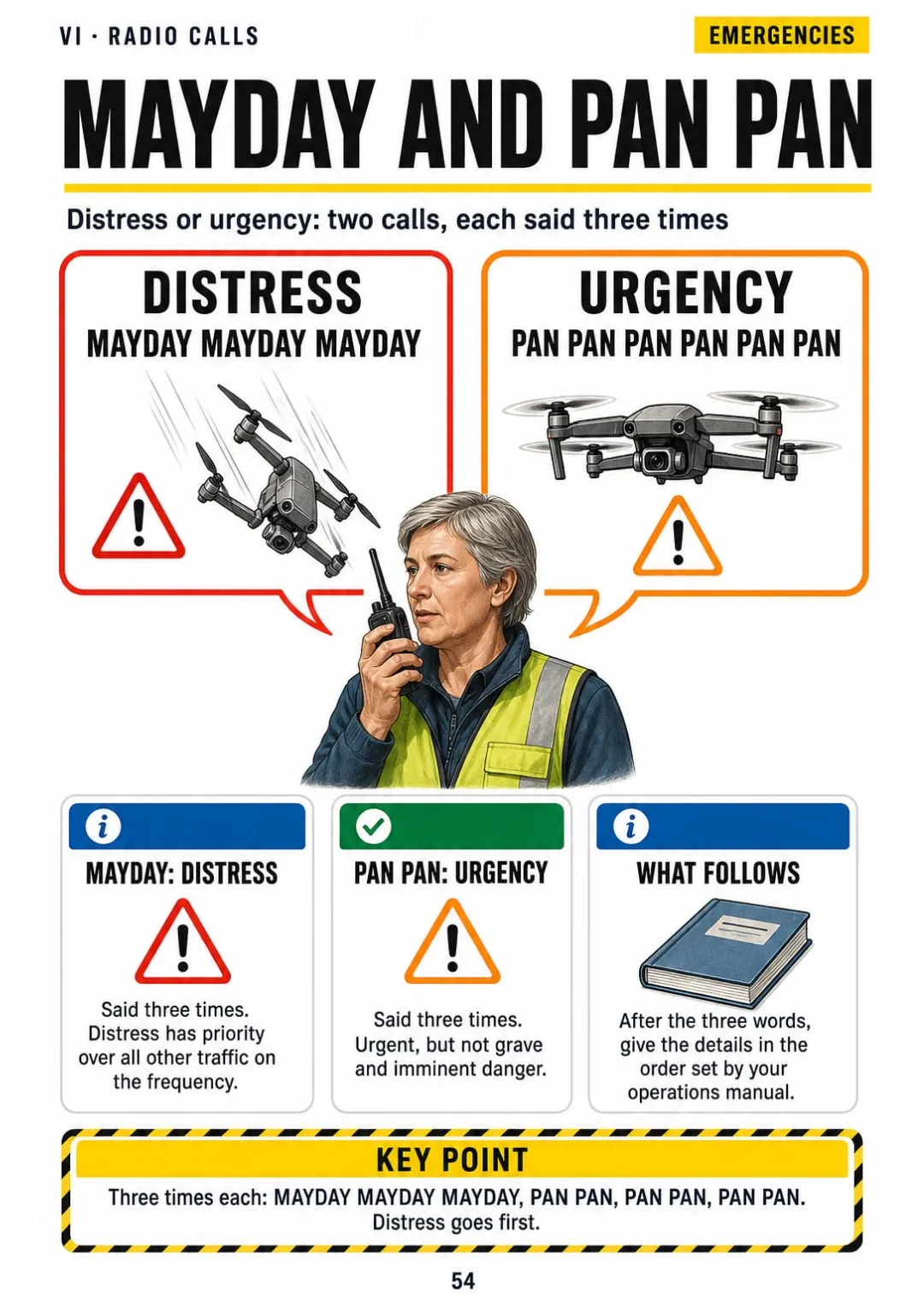
Distress and urgency calls side by side, each spoken three times
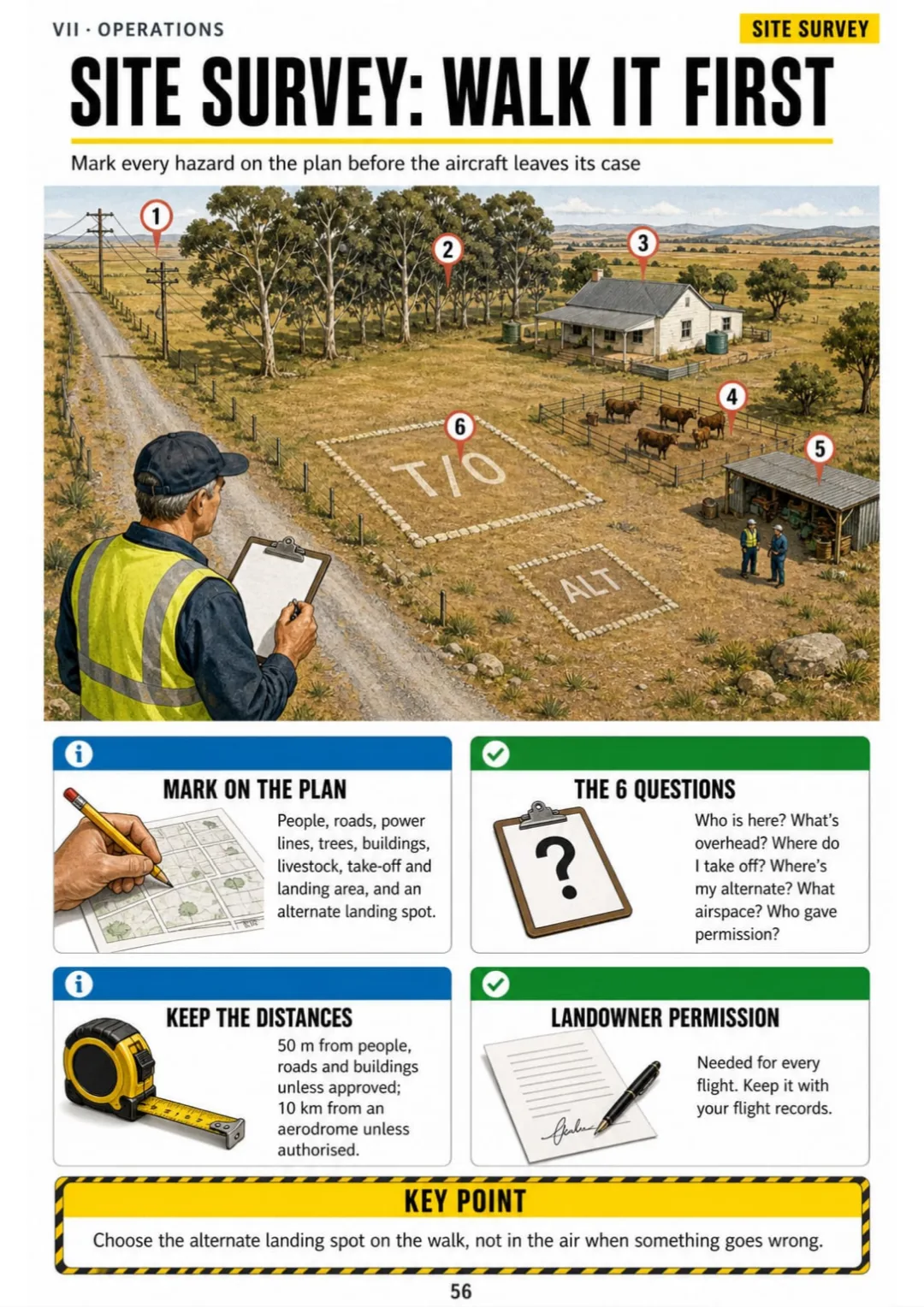
Site plan: hazards, take-off pad, alternate spot and the 6 questions for every job
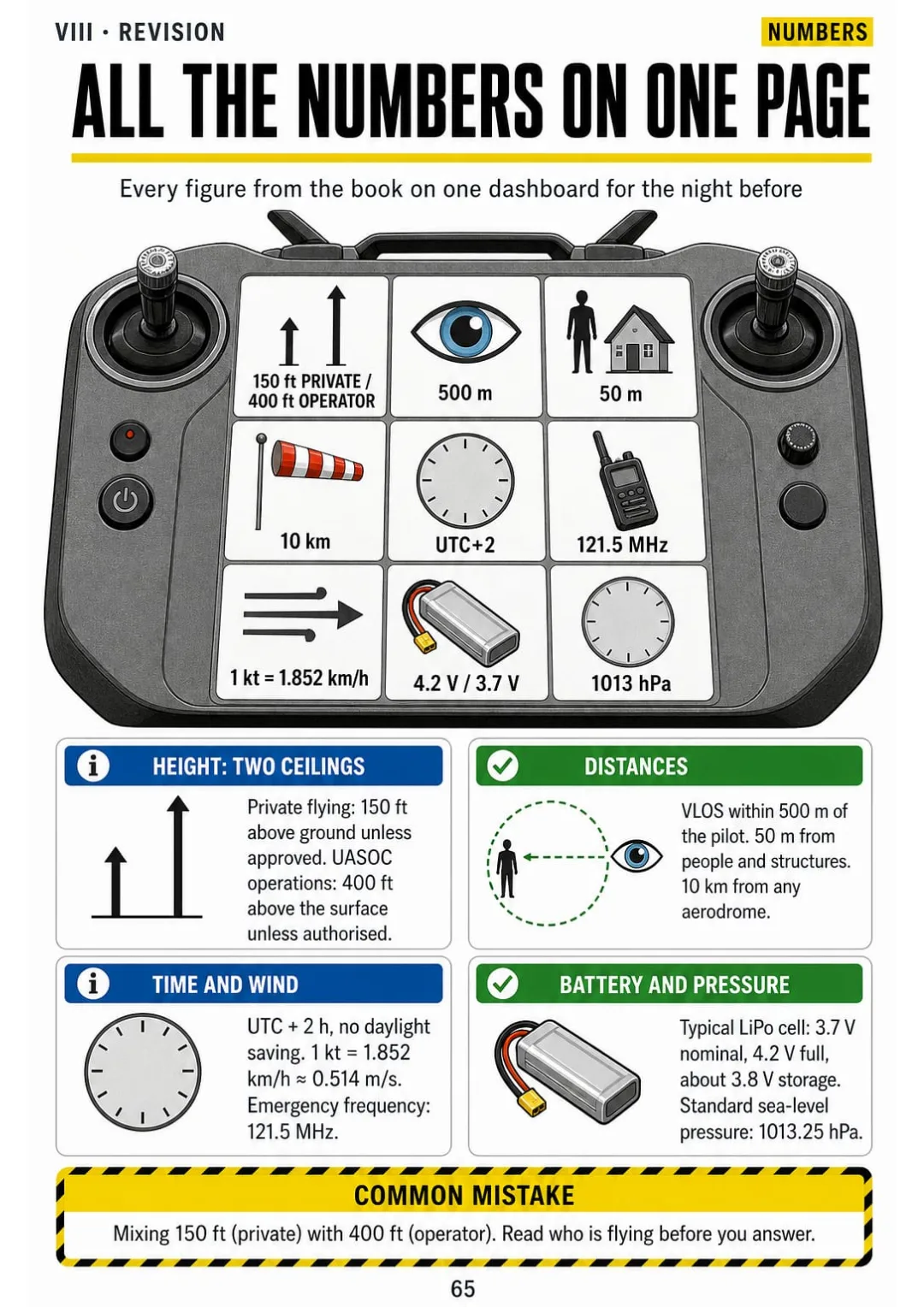
150 ft private, 400 ft operator, 500 m, 50 m, 10 km, UTC+2: all on one page

Swipe to see more →

These are real pages from the book. The table of contents is the full one: 8 parts and 65 topics.

The Problem Isn't You. It's How It Was Explained to You.

You're planning a job a few kilometres from an airfield and the client wants the photos by Friday. You open the chart and see circles, letters and numbers stacked on top of each other.

The school manual covers CTRs, TMAs and ATZs in paragraphs: lower limits, upper limits, distances, one after the other. Three pages in, the shapes still won't stand up in your head.

The SA AIP lists the Johannesburg FIR and the Johannesburg Oceanic FIR.

In the book, that same airspace is a layer cake: each type drawn as a slice over the ground, with the CTR starting at the surface, and its limits written alongside.

The same goes for the 50-metre rule, reading a METAR, LiPo voltages, the order of a radio call and what to do on lost link: each one has its own page.

You look at the drawing and you know where you can fly, and you plan the job without going back to the manual.

COMPARE FOR YOURSELF

The Same Topic, Two Ways to Study It

THIS
  • The manual: line after line
  • Height limits explained only in words
  • You walk into the exam with doubts
In terms of the applicable provisions, a remotely piloted aircraft shall not be operated at a height exceeding the limit prescribed for the relevant category of operation, unless otherwise approved. For private operations the maximum height is 150 ft above the surface, whereas operations conducted under an RPAS operator certificate may be conducted up to 400 ft above ground level, such height being measured from the surface beneath the aircraft, subject to any further restrictions applicable to the airspace concerned.
FOR THIS
  • Your ceiling in one drawing
  • 150 ft and 400 ft in a box
  • You see it and you get it
150 ft for private flying, 400 ft AGL for UASOC operations, both measured from the ground
CONTENTS

Take a Look at the 8 Parts and 65 Topics

The licence, air law, airspace and charts, weather, the aircraft and batteries, radio calls, pre-flight and emergencies, and a final revision: 69 pages, all illustrated

IThe licence and who does what · pp. 5-12
  1. What the Remote Pilot Licence lets you do
  2. Private, commercial or corporate: which one is your job
  3. The four documents for paid work
  4. The road to the RPL, step by step
  5. RPAS classes by mass and energy
  6. Who's who: SACAA, ATNS, Department of Transport
  7. Your logbook and keeping the licence current
  8. The operations manual and roles in a ROC
IIAir law in the field · pp. 13-21
  1. 400 ft above the surface: your ceiling
  2. Visual line of sight: 500 metres, unaided eyes
  3. The 50-metre rule: people, buildings, roads
  4. 10 km from an aerodrome
  5. Places you never fly over without approval
  6. Day only, unless approved
  7. Dropping, spraying and carrying
  8. Right of way: manned aircraft always first
  9. Accidents and incidents: what you report
IIIAirspace and charts · pp. 22-30
  1. South African airspace as a layer cake
  2. CTR, TMA and ATZ: the shapes around airports
  3. The flight information regions
  4. Reading an aeronautical chart: the symbols
  5. FAP, FAR, FAD: prohibited, restricted, danger
  6. AGL, AMSL and flight levels
  7. Coordinates: latitude south, longitude east
  8. NOTAMs: the changes the chart doesn't show
  9. Planning a site near an aerodrome: worked example
IVWeather for drone pilots · pp. 31-39
  1. Wind: km/h, knots and metres per second
  2. Gusts and turbulence round buildings and ridges
  3. Highveld thunderstorms
  4. Temperature and battery performance
  5. Density altitude: why Johannesburg flies differently
  6. Visibility, fog and cloud base
  7. Reading a METAR line by line
  8. Reading a TAF: BECMG, TEMPO, PROB30
  9. Pressure and QNH in hPa
VThe aircraft, the link and the batteries · pp. 40-47
  1. The RPAS is a system, not just a drone
  2. How a multirotor moves: thrust, pitch, roll, yaw
  3. LiPo cells: the voltages to remember
  4. Battery reserve: land before you need to
  5. Charging, storage and transport
  6. GPS, compass and attitude mode
  7. The command and control link
  8. Mass, payload and centre of gravity
VIRadio calls and aviation English · pp. 48-55
  1. The phonetic alphabet and numbers
  2. The order of every call
  3. Readback: what you must repeat
  4. Standard words: ROGER, WILCO, AFFIRM, NEGATIVE
  5. Worked call: an RPAS job inside a CTR
  6. Time on the radio: UTC and local time
  7. MAYDAY and PAN PAN
  8. The restricted radio and English assessment
VIIPre-flight, operations and emergencies · pp. 56-64
  1. Site survey: the walk before the flight
  2. Risk assessment: likelihood times severity
  3. The pre-flight check, always in the same order
  4. Fit to fly: IMSAFE
  5. Pilot and observer: who says what
  6. Lost link: what the aircraft does, what you do
  7. Fly-away and GPS loss
  8. Manned aircraft on the way
  9. After a crash or battery fire
VIIIRevision and final checklist · pp. 65-69
  1. All the numbers on one page
  2. The abbreviations decoded
  3. Questions that get mixed up
  4. How to work through a multiple-choice question
  5. Final checklist: before the exam and your first paid job

One Page, One Topic, All Clear

Think of it this way:

A farmer rings: he wants his maize fields filmed before harvest, and a provincial road runs along the fence. The wind is picking up. You need to know in a minute whether you can take the job.

You open the book at the 50-metre rule and see the field, the road and the farmhouse drawn with the gap marked, and in part 4, the wind in km/h and knots side by side.

Aircraft, pilot station, C2 link, payload, launch and recovery: one system

The same with wind in km/h and knots, the battery reserve, the pre-flight check, a radio call inside a CTR and lost link: each one on its own page.

Drone Pilot Licence Illustrated is 8 parts and 65 topics, all drawn, and it ends with all the numbers on one page, the abbreviations decoded and a final checklist.

What you see drawn, you don't have to memorize.

What's Inside Drone Pilot Licence Illustrated:

Ipp. 5-12

The licence and who does what

What the licence lets you do, private, commercial or corporate, the four documents for paid work, RPAS classes, who's who, the logbook and the operations manual

IIpp. 13-21

Air law in the field

The 400 ft ceiling, visual line of sight at 500 metres, the 50-metre rule, 10 km from an aerodrome, places you never fly over, day only, dropping and spraying, right of way and what you report

IIIpp. 22-30

Airspace and charts

Airspace as a layer cake, CTR, TMA and ATZ, the flight information regions, chart symbols, prohibited, restricted and danger areas, AGL and AMSL, coordinates, NOTAMs and a worked site near an aerodrome

IVpp. 31-39

Weather for drone pilots

Wind in km/h, knots and m/s, gusts round buildings and ridges, Highveld thunderstorms, temperature and batteries, density altitude, visibility, METAR, TAF and QNH in hPa

Vpp. 40-47

The aircraft, the link and the batteries

The RPAS as a system, how a multirotor moves, LiPo voltages, battery reserve, charging and transport, GPS and attitude mode, the C2 link and centre of gravity

VIpp. 48-55

Radio calls and aviation English

The phonetic alphabet and numbers, the order of every call, readback, standard words, a worked call inside a CTR, UTC and local time, MAYDAY and PAN PAN, and the radio assessment

VIIpp. 56-64

Pre-flight, operations and emergencies

Site survey, risk assessment, the pre-flight check in the same order, IMSAFE, pilot and observer, lost link, fly-away, manned aircraft on the way and after a crash or battery fire

VIIIpp. 65-69

Revision and final checklist

All the numbers on one page, the abbreviations decoded, the questions that get mixed up, how to work through a multiple-choice question and the final checklist

At the end of the book: All the numbers on one page, the abbreviations decoded, the questions that get mixed up and a final checklist.
Plus: 2 Free Books

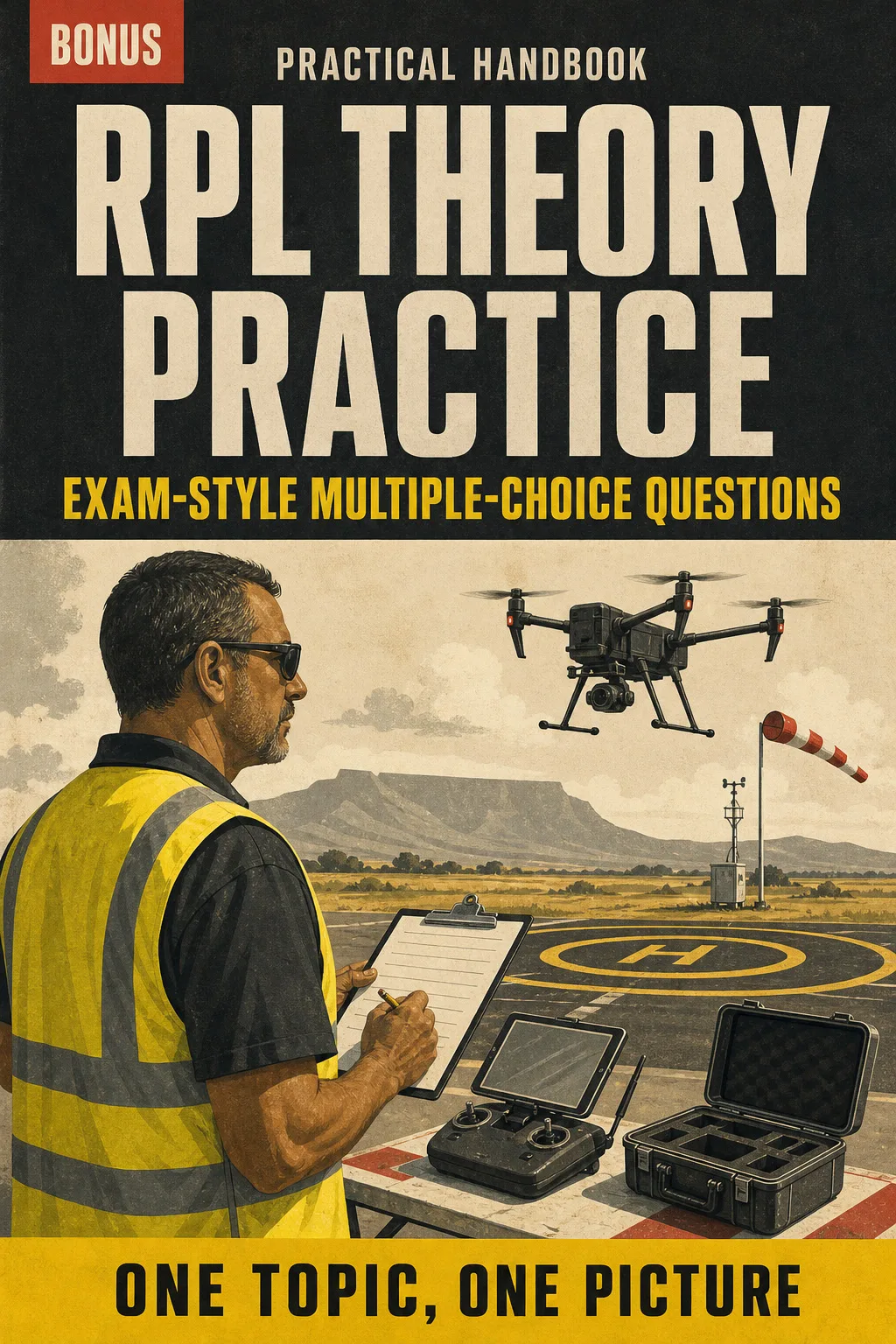
RPL Theory Practice: Exam-Style Multiple-Choice Questions

BONUS 1: «RPL Theory Practice: Exam-Style Multiple-Choice Questions»

Value on its own: US$ 17.90

Test yourself topic by topic with exam-style questions and a short explanation for every answer, so you know what to revise before the theory exam.

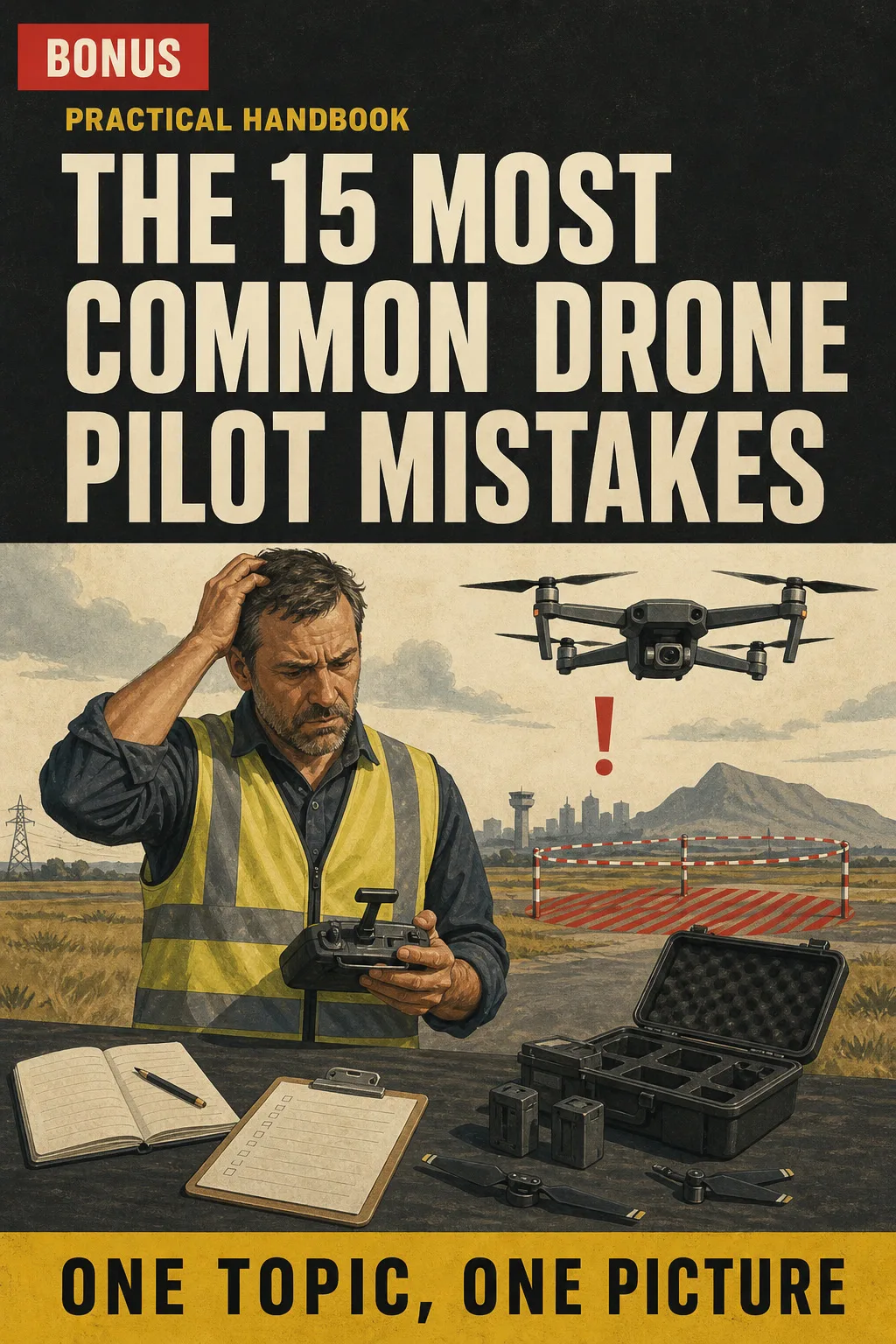
The 15 Most Common Drone Pilot Mistakes

BONUS 2: «The 15 Most Common Drone Pilot Mistakes»

Value on its own: US$ 14.90

Each frequent mistake drawn before and after, from launching in gusty wind to forgetting the battery reserve, so you spot it before it happens on a job.

Drone Pilot Licence Illustrated with 2 Free Books

  • Drone Pilot Licence Illustrated: 69 illustrated pagesUS$ 63
  • BONUS 1: RPL Theory Practice: Exam-Style Multiple-Choice QuestionsUS$ 17.90
  • BONUS 2: The 15 Most Common Drone Pilot MistakesUS$ 14.90
  • High-resolution PDF to printIncluded
Total value US$ 95.80
YOUR PRICE:
US$ 27
You save US$ 68.80
YES, I WANT DRONE PILOT LICENCE ILLUSTRATED FOR US$ 27

📄 This is a digital PDF book sent to your email: nothing is printed or shipped.

Secure purchaseEncrypted payment30-day guarantee

PDF by email: We email you Drone Pilot Licence Illustrated as a PDF, together with the two free books. It's a single payment: no installments, no extra charges.

Who This Book Is For

You're doing the RPL course

You're doing the RPL course

Next to the school's manual, every topic has its own drawn page: you revise at night and the next day it's still there.

The theory exam and radio assessment are close

The theory exam and radio assessment are close

All the numbers on one page, the calls in the same order and exam-style questions to see what you still need to revise.

You already fly paid jobs

You already fly paid jobs

Wind, battery reserve, the site survey and emergencies drawn as steps, to have at hand before every job.

Everything You Get Today

US$ 95.80US$ 27
YES, I WANT DRONE PILOT LICENCE ILLUSTRATED FOR US$ 27

📄 This is a digital PDF book sent to your email: nothing is printed or shipped.

30DAYS
GUARANTEE

30-Day Guarantee

Try Drone Pilot Licence Illustrated for 30 days, bonus books included.

We refund everything if the file won't open, if the book isn't what you see here, if you were charged twice or if the email doesn't arrive. Just email us.

You pay once. No subscriptions.

Frequently Asked Questions

Is it for me if I've been flying for years and just need the licence?

Yes. It doesn't teach you to fly: it puts the theory for the Remote Pilot Licence in order, air law, airspace, weather, radio and emergencies, one topic per page, so you can revise what the exam and the job ask of you.

Where does the content come from?

Each page is checked against the South African Civil Aviation Regulations, Part 101 and its Technical Standards, and the Part 172 airspace rules. Regulations get amended, so always confirm against the current version; wind and battery limits also depend on your manufacturer's manual.

Is it official material?

No. It's an independent illustrated study book. It is not published, approved or endorsed by the SACAA or by any RPAS training organisation, and it does not give you a certificate or count as training hours: you get those at your approved training organisation.

Does it replace the course at an approved training organisation?

No. The licence needs the theory, practical and radio training at an approved RPAS training organisation. This book goes alongside the course so you can revise.

Are the practice questions the ones in the exam?

No. They are exam-style questions written for this book, with a short explanation for each answer. They are not official exam questions.

When and how does it arrive?

As a PDF by email, to the address you enter at checkout. The 2 bonus books come the same way.

Do I have to pay every month?

No. It's a single payment, with no subscription.

Can I have it on paper?

Yes. The PDF is made to print, at home or at a print shop, so you can keep it in the vehicle or the kit bag.

How does the refund work?

You have 30 days. We refund everything if the file won't open, if the book isn't what you see on this page, if you were charged twice or if the email doesn't arrive: just email us.

Before You Close This Page

No more rereading the manual with nothing sticking.

Airspace, wind and radio calls: you see them drawn.

You walk into the exam and onto the job knowing where everything is.

Drawings make studying faster.

The book is right below.

One-time payment: US$ 27 · Guarantee: 30 days · PDF by email

YES, I WANT DRONE PILOT LICENCE ILLUSTRATED FOR US$ 27

📄 This is a digital PDF book sent to your email: nothing is printed or shipped.